Friday, 1 December 2017

BLACK KNIGHT of NURNBURG (Monogram)

The Black Knight of Nurnburg is a re-re-re-release of a late 1950s kit, and is now presented by Monogram/Revell in 1:8 scale as part of a series of knight kits.

The basic paint is Alclad back undercoat, which is detailed with silver paint pen, and a Japanese gold paint fine tip pen. Then the whole thing is lightly oversprayed with a fine mist of Alclad black base coat again to make the silver and gold look like real engraved and embossed metal parts. It was also my first attempt at flesh tones and faces. I glossed in the eyes, and gave a satin finish to the hair.
The base in the kit is boring, so I added gesso and texture and moss and dirt and grasses.

It took a third place ribbon at the IPMS Ottawa December out-of-box contest.

UPDATE: This model placed first in the giant CAPCON biennial model contest on 28 September 2019 at the Canadian War Museum in Ottawa. (Collections - Theme (groups of 5 knights in armour))

Black Knight of Nurnburg

Black Knight of Nurnburg

Actual armour on display at the Cdn War Museum

Black Knight of Nurnburg

Black Knight of Nurnburg

Black Knight of Nurnburg

Black Knight of Nurnburg

Black Knight of Nurnburg

Black Knight of Nurnburg

Black Knight of Nurnburg

Black Knight of Nurnburg


Black Knight of Nurnburg


Black Knight of Nurnburg

This model placed first in the giant CAPCON biennial model contest on 28 September 2019 at the Canadian War Museum in Ottawa. (Collections - Theme (groups of 5 knights in armour))

NORTH AMERICAN X-15 HYPER-AIRCRAFT (Revell)

This is the Revell 1:64 (so-called Box Scale) North American X-15 Hyper-Aircraft.
Most of the aircraft were a gun metal black with a blueish tinge, but a few flights sported a white ablative material to test how special ablative coatings burned off at re-entry speeds, thus protecting the craft from the heat. The aircraft was launched at very high altitudes from the wing pylon on a B-52 bomber. The X-15's officially-recognized world speed record for a manned, powered aircraft was set in October 1967 with a speed of Mach 6.72 at an altitude of 31 km. This is 7,274 km/hr, or 2 km per second. This means it could not possibly carry it's own fuel, so had massive fuel tanks attached under each side. Full speed flight time was measured in second.

The gloss white is Krylon spray can paint.The kit came with white markings for a black surface, so most of the decals came from the IPMS Ottawa decal bank. It includes a pilot in the cockpit, who is barely visible in the photos.

Length: 15.5 m
Wing: 6.8 m
Empty weight: 6.6 tonnes
Loaded weight: 15.4 tonnes
Max speed: 7200 km/hr
Range: 450 km
Ceiling 100 km

North American X-15 Hyper-Aircraft

North American X-15 Hyper-Aircraft
A real one in later years...

North American X-15 Hyper-Aircraft

North American X-15 Hyper-Aircraft

North American X-15 Hyper-Aircraft

North American X-15 Hyper-Aircraft

North American X-15 Hyper-Aircraft

North American X-15 Hyper-Aircraft


North American X-15 Hyper-Aircraft

North American X-15 Hyper-Aircraft

North American X-15 Hyper-Aircraft

North American X-15 Hyper-Aircraft

North American X-15 Hyper-Aircraft

North American X-15 Hyper-Aircraft

North American X-15 Hyper-Aircraft

North American X-15 Hyper-Aircraft

North American X-15 Hyper-Aircraft

North American X-15 Hyper-Aircraft

North American X-15 Hyper-Aircraft

Sunday, 1 October 2017

CANADIAN WAR MUSEUM AWARD

WINNER of the CAPCON 2017 "Canadian War Museum Award" for a model of an item from the museum's collection. 30 September 2017.

This is a 1:35 scale kit from Tamiya of the M113 armoured personnel carrier as used by the Canadian Army on the United Nations UNPROFOR peacekeeping mission in the former Yugoslavia.

On 24 April 1993 this APC was damaged beyond repair when it drove onto an anti-tank land mine during route reconnaissance of the front lines in Srebrenica, Bosnia-Herzegovina.

The APC was part of Golf Company, 2nd Battalion, The Royal Canadian Regiment.

Injured was Lt Cameron Ellis; as well as WO Hickey; Cpl Jane and Cpl MacDougall; and Pvt O'Neill.

The vehicle is now part of the collection at the Canadian War Museum. It was completely restored in honour of 30 years of service by the M113 APC family to the Canadian Armed Forces.

The entire top/roof had to be rebuilt to eliminate the large armoured heavy gun turret and to add a new flat sheet (of trading card cardboard), and to add a new smaller ring turret, and a new hatch.

The license plate is the very unique "35000" registration, and is a tiny photograph of the actual plate on the real vehicle. I look the photo then shrunk it down to almost nothing, then printed it on the colour laser printer and cut out the final plate to glue directly to the hull. With a magnifying glass you could read the word CANADA on the top of the plate.

Work began on 3 August and was completed on 26 August.


The real one damaged in former Yugoslavia

The real one rebuilt and on display in the Canadian War Museum


Wednesday, 20 September 2017

50th Anniversary of Launch of Cunarder "QUEEN ELIZABETH 2"

Today is the 50th anniversary of the launch of the ocean liner QE2 in Scotland.

This lovely night shot shows the QE2 in Sydney Harbour during her final round-the-world voyage on early 2007. I was aboard. It was a magnificent voyage!

photo by Merbabu

Tuesday, 19 September 2017

CUNARD "QUEEN ELIZABETH 2" (QE2) 50th ANNIVERSARY of LAUNCHING

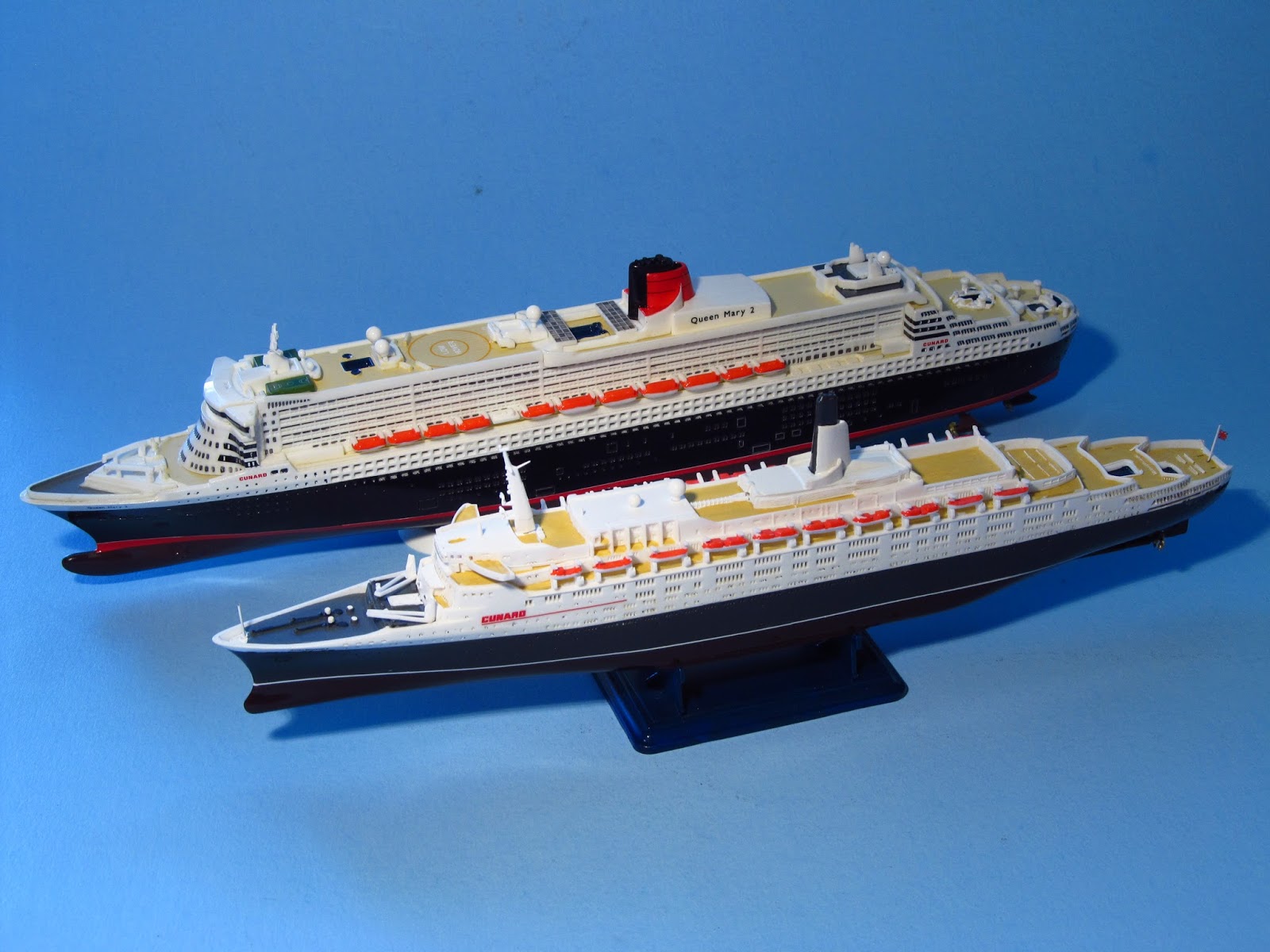
To celebrate the 50th anniversary of the launch of the greatest ocean liner ever built, here are some photos of my recently-completed QE2. The ship was launched 20 September 1967 in Scotland.
The RMS Queen Elizabeth 2 immediately became the Cunard flagship, and sailed hundreds of crossings and 26 round-the-world voyages. The QE2 was Cunard's longest-serving ocean liner.

This is the Revell 1:1200 scale model of the best ocean liner ever built - the QE2. The small box kit gives a finished hull only 25 cm in length.

I sailed around the world on this ship - it is a fantastic way to spend 4 months.
Sadly the ship is now retired and decaying in the UAE.

The model shows the QE2 as she appeared after 1982 when the ship was used by the British as a military troop transport for the Falklands/Malvinas war. The funnel is still the original white. The Cunard orange/red was a later addition to the paint scheme.

The year 1967 saw the first look at Concorde, and the first flight of the Saturn V rocket.
 
QE2

QE2


Photo of actual launch of the QE2 on 20 September 1967 at Clydebank, Scotland.  The Queen managed to name it after herself with these words: "I name this ship Queen Elizabeth the Second. May God bless her and all who sail in her." Cunard cleverly reworked the name and used the digit "2" in the name instead of the roman numeral "II" or the word "second". Thus was born the QE2.

QE2 (1967) with the new (2004) Queen Mary 2.


QE2 (1967) with the new (2004) Queen Mary 2.

QE2 (1967) with the new (2004) Queen Mary 2.

QE2 (1967) with the new (2004) Queen Mary 2.

QE2 (1967) with the new (2004) Queen Mary 2.

QE2 (1967) with the new (2004) Queen Mary 2.