Sunday, 15 March 2020

CANADIAN "VENGEANCE" V-1 WEAPON (MPM)

This is a 1:48 scale model of one of several German Fi-103 V-1 "Vergeltungswaffe 1" Vengeance Weapon #1 captured by the Canadian Army at the end of World War II.

These flying bombs, the earliest operational cruise missiles, made their way back to Canada as intelligence trophies, and after a short examination ended up on display at a couple of RCAF air bases and then being given to museums such as the National Aeronautical Collection and the Canadian War Museum.

There are no good photos, so the paint scheme is pure conjecture. Each would have had several coats of paint - each determined by the supply officer who gave available paint to junior ranks to spruce up the base. I thank IPMS Canada for publishing a couple of partial photos of these beasts in Canada. Decals are also courtesy of the wonderful IPMS Canada decal sheets included each year with Random Thoughts magazine. White is Tamiya spray can, and red is Testors spray can.

Technical name Fi-103
Designer Robert Lusser
Manufacturer Fieseler
Mass 2150 kg 
Length 8.32 m 
Width 5.37 m 
Height 1.42 m 
Warhead weight 850 kg 
Engine Argus As 109-014 Pulsejet
Operational range 250 km 
Speed 640 km/h

RCAF V-1 "Vergeltungswaffe"

RCAF V-1 "Vergeltungswaffe"


RCAF V-1 "Vergeltungswaffe"

RCAF V-1 "Vergeltungswaffe"

RCAF V-1 "Vergeltungswaffe"

RCAF V-1 "Vergeltungswaffe"

RCAF V-1 "Vergeltungswaffe"

RCAF V-1 "Vergeltungswaffe"

RCAF V-1 "Vergeltungswaffe"

RCAF V-1 "Vergeltungswaffe"

RCAF V-1 "Vergeltungswaffe"

RCAF V-1 "Vergeltungswaffe"

Tuesday, 10 March 2020

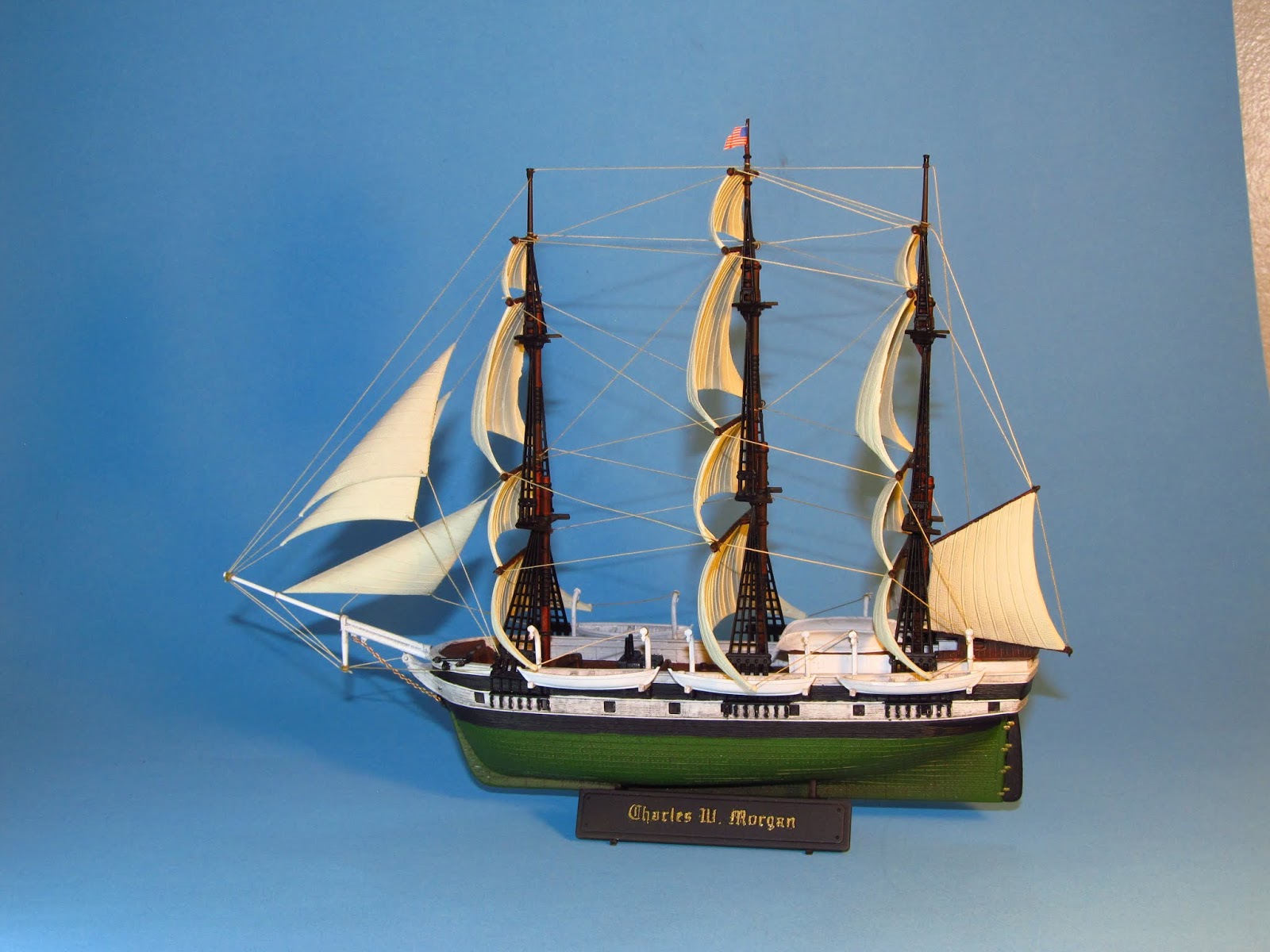
NEW BEDFORD WHALER (Academy)

This is a 1:200 scale model of a New Bedford whaling ship named Charles W. Morgan.  (Academy kit #14204)

It is a 72 hour build from purchase to finish. Try it sometime. It is a great way to rekindle why you got into the hobby to begin with. Enjoy a weekend of building just for fun.

The rat lines are moulded, and the four sails for each mast come as an attached set. You have to add the rat lines (the trickiest part of the build), and then add the sail set to each mast. Once everything is in place then the rigging begins. I used mercerized cotton thread. The thread cost half as much as the kit, but with a few hundred metres of it the spool will last for years.

Paints are Vallejo acrylics. I spray painted everything before a single part was glued. I added the golden chain connecting the prow to the bowsprit, and then added a small flag. Everything else is out of box.

In 1835 the Massachusetts town of New Bedford (on the north Atlantic) was a true whaling capital. Over 430 whaling sailing vessels were registered on the town books. The whales were nowhere nearby, so these ships often plied the Pacific ocean looking for whales. Whaling voyages, in search of sperm whales to render into oil for Massachusetts factory machinery, could last up to three years.

New Bedford whaling ship (c. 1835) Charles W. Morgan

New Bedford whaling ship (c. 1835) Charles W. Morgan

New Bedford whaling ship (c. 1835) Charles W. Morgan

New Bedford whaling ship (c. 1835) Charles W. Morgan

New Bedford whaling ship (c. 1835) Charles W. Morgan

New Bedford whaling ship (c. 1835) Charles W. Morgan

New Bedford whaling ship (c. 1835) Charles W. Morgan

New Bedford whaling ship (c. 1835) Charles W. Morgan

New Bedford whaling ship (c. 1835) Charles W. Morgan

New Bedford whaling ship (c. 1835) Charles W. Morgan

New Bedford whaling ship (c. 1835) Charles W. Morgan

New Bedford whaling ship (c. 1835) Charles W. Morgan

New Bedford whaling ship (c. 1835) Charles W. Morgan

New Bedford whaling ship (c. 1835) Charles W. Morgan

New Bedford whaling ship (c. 1835) Charles W. Morgan

New Bedford whaling ship (c. 1835) Charles W. Morgan

New Bedford whaling ship (c. 1835) Charles W. Morgan

New Bedford whaling ship (c. 1835) Charles W. Morgan

New Bedford whaling ship (c. 1835) Charles W. Morgan

New Bedford whaling ship (c. 1835) Charles W. Morgan

SHIPBUILDING IN PROGRESS OVER THE WEEKEND....


Sunday, 1 March 2020

CARNOTAURUS SASTREI

This is a very large PVC plastic model from an unknown Chinese factory of what may be a CARNOTAURUS SASTREI (meat-eating bull) dinosaur from about 70 million years ago.

Most dinosaurs shown in museums have a characteristic brown/mineral/stone colour due to the fossilization process. The Canadian Museum of Natural History shows on dinosaur in natural bone colour. This model is done to mimic that dinosaur.

The model is about 75 cm long. It is painted in Vallejo shades of white. It was annoying to build because there is what seems to be an extra vertebrae; a missing forelimb; and part numbers embossed on each part. The PVC plastic is heavy but very bendy and pliable. I built a new forelimb from toothpicks and cyanoacrylate and baking soda. I added moss to the base. The kit comes with the metal poles holding up the heavy skeleton.

CARNOTAURUS SASTREI

CARNOTAURUS SASTREI

CARNOTAURUS SASTREI

CARNOTAURUS SASTREI

CARNOTAURUS SASTREI

CARNOTAURUS SASTREI

CARNOTAURUS SASTREI

CARNOTAURUS SASTREI

CARNOTAURUS SASTREI


Friday, 28 February 2020

SANTA MARIA (Lindberg)

This is the rather old (1966) plastic model from The Lindberg Line of the SANTA MARIA ship used by Colombus as his flagship on the sponsored voyage to find the western route to India. The real ship had two names: the Santa Maria (Saint Mary), and La Gallega (Galicia), as was common to Spanish ships of that era.

It is a Nao-type ship with 150 tonnes displacement.
Length of hull 19 m (estimates)
Beam 5.5 m
Draught 3.2 m
Crew: 42 persons including Captain Juan de la Cosa and Admiral Christopher Colombus (original name: Cristoffa Corombo in Ligurian)
This was a very small boat.

The model hull is a mere 18 cm long, and fits neatly in my hand.

The voyage was principally financed by a syndicate of seven noble Genovese bankers resident in Seville, with funding from Lorenzo di Pier Francesco de Medici of Fiorenza.

It is not known when Santa Maria/Gallega was built, or for how many years this used ship sailed before being impressed into the expedition. What is known is that on 25 December 1492 it sailed onto what is now Haiti and was lost while the officers and crew slept.

The first (and only exploration) voyage of the Santa Maria/Gallega began in Spain on 03 August 1492; then departed the Canary islands on 06 September; and was successful when the ships reached land at either Turks and Caicos, or Bahamas, on 12 October 1492. It took about 36 days to sail the last leg of 5700 km (straight line distance). If they were on the shortest route it would have been a speed of about 6.6 km/hr.

The group sailed around the region for another two and a half months (mostly along the north-east cost of Cuba), finding and renaming islands already occupied, until the ship was grounded on the island of Hispanolia near present day Cap-Haitien. Timbers from the ship were used to build Fort Christmas near the wreck. No one knows for certain what the ship actually looked like or how it was rigged. There are no drawings from the time - only current conjecture based on similar ships of the era.

The model is largely out-of-box, but with a lot of painting and rigging added. I replaced the plastic vacuform sails with cloth and stitching, and replaced the black rubber ratlines. The 54 year old decals worked surprisingly well. The tender (or lifeboat) was rebuilt with provisions, oars, a sail, a mast, and tie-downs. The rear mast had to be replaced in total with a metal pole. The real ship had about 6 anchors, but only two are moulded here. I built and added all deck railings and stair railings. Paint is all Vallejo acrylics, mostly airbrushed.

The rungs on the ratlines are made from solid string which is made by rubbing cyanoacrylate glue along regular string which is stretch tight. Then the rods of string are glued horizontally onto the upright lines.

The base is a single cheap plaque from a dollar store with scribed board lines, peg holes, and weathering, and with decorative rope added around the border.


Santa Maria / La Gallega ship used by Colombus on his first voyage to India, 1492.

Santa Maria / La Gallega ship used by Colombus on his first voyage to India, 1492.

Santa Maria / La Gallega ship used by Colombus on his first voyage to India, 1492.

Santa Maria / La Gallega ship used by Colombus on his first voyage to India, 1492.

Santa Maria / La Gallega ship used by Colombus on his first voyage to India, 1492.

Santa Maria / La Gallega ship used by Colombus on his first voyage to India, 1492.

Santa Maria / La Gallega ship used by Colombus on his first voyage to India, 1492.

Santa Maria / La Gallega ship used by Colombus on his first voyage to India, 1492.

Santa Maria / La Gallega ship used by Colombus on his first voyage to India, 1492.

Santa Maria / La Gallega ship used by Colombus on his first voyage to India, 1492.

Santa Maria / La Gallega ship used by Colombus on his first voyage to India, 1492.

Santa Maria / La Gallega ship used by Colombus on his first voyage to India, 1492.

Santa Maria / La Gallega ship used by Colombus on his first voyage to India, 1492.

Santa Maria / La Gallega ship used by Colombus on his first voyage to India, 1492.

Santa Maria / La Gallega ship used by Colombus on his first voyage to India, 1492.

Santa Maria / La Gallega ship used by Colombus on his first voyage to India, 1492.

Santa Maria / La Gallega ship used by Colombus on his first voyage to India, 1492.

Santa Maria / La Gallega ship used by Colombus on his first voyage to India, 1492.

Santa Maria / La Gallega ship used by Colombus on his first voyage to India, 1492.

Santa Maria / La Gallega ship used by Colombus on his first voyage to India, 1492.

Santa Maria / La Gallega ship used by Colombus on his first voyage to India, 1492.

Santa Maria / La Gallega ship used by Colombus, by Lindberg models from 1966

in the shipyard...
in the shipyard...

in the shipyard...

in the shipyard...

in the shipyard...

Confused Europeans claiming someone else's land for the hereditary Spanish monarchy and the catholic church.